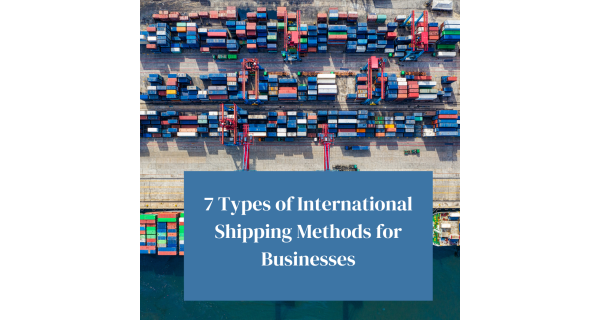
Shipping products across borders can feel like solving a big puzzle; one wrong piece, and costs rise or deliveries are delayed.
For businesses, choosing the right international shipping method is more than just moving goods; it shapes profit margins, customer satisfaction, and even brand reputation.
In this article, we’ll explore seven practical international shipping methods to help businesses match their needs with the best option, making global trade smoother, faster, and more cost-effective.

1. Air Freight Shipping
One of the quickest ways to ship goods internationally is by air freight, which is perfect for urgent, expensive, or perishable goods. Do you need something delivered right away, or is it pricey and breakable?
Air freight has you covered, offering top-speed transit, tight security, and expansive global reach.
However, there are significant size and weight restrictions, and air freight can be much more expensive than sea or land shipping. As a result, this speed comes at a premium.
Consider medical supplies or electronics; getting them into the air quickly can save the day and occasionally the shipment.
2. Ocean Freight Shipping

When businesses think of cost-effective types of international shipping methods, ocean freight often comes to mind. It’s the go-to choice for moving bulky, heavy, or non-perishable goods across long distances.
While it takes more time compared to air freight, it allows companies to transport massive volumes at a fraction of the cost. Containers can handle everything from cars and machinery to raw materials.
The main trade-off is speed, as sea routes are slower and can face delays at ports. Still, for businesses prioritizing affordability over urgency, ocean freight is a reliable and widely used option.
3. Courier & Express Shipping
Among the most practical international shipping options for companies that handle smaller packages are courier and express services.
They are particularly well-liked by e-commerce companies that require quick, door-to-door delivery for clients around the world.
Reliable speed, thorough tracking, and the assurance that comes with using reputable companies like DHL, FedEx, or UPS are the obvious advantages. However, there are size restrictions that make it less suitable for large orders, and the price per package can be high.
For companies that ship apparel, accessories, or product samples, expedited shipping is frequently the most effective strategy to maintain satisfied and devoted clients.
4. Road Freight (Cross-Border Trucking)
One of the most useful international shipping options for companies operating in land-connected areas is road freight. It’s a flexible option that allows goods to move directly from warehouses to stores or customers without multiple transfers.
Compared to air or sea, it’s often more affordable for medium distances and can handle a wide range of cargo.
The downside is that it only works between countries with accessible borders, and customs checks can cause delays.
Still, for businesses shipping goods within regions like West Africa or across Europe, road freight offers a reliable and cost-friendly solution.
5. Rail Freight Shipping
Rail freight is another dependable option among the types of international shipping methods, especially for moving large volumes over long land routes.
It strikes a balance between cost and efficiency, making it suitable for bulk goods like raw materials, agricultural products, or manufactured items.
Trains follow fixed schedules, which helps businesses plan more reliably than with road transport. On the plus side, rail freight is environmentally friendly and can carry heavy loads with ease.
The drawback is limited flexibility—it only works where railway networks connect. For companies trading between Europe and Asia, rail freight has become a trusted choice.
6. Intermodal Shipping (Combination of Modes)
Combining two or more modes of transportation, such as road, rail, and sea, to move goods efficiently makes intermodal shipping one of the most flexible forms of international shipping.
Businesses can use this method to balance dependability, cost, and speed based on the route and cargo. For example, cargo may arrive by sea, then be transported inland by rail before being delivered by truck.
Reduced handling risks and flexible routing are the advantages, but careful coordination is needed, which occasionally results in delays. Intermodal shipping is a clever method of logistics optimization for businesses with intricate supply chains.
7. Drop Shipping (Third-Party Fulfillment)
One of the newest international shipping strategies is drop shipping, which is intended for companies that sell goods online without maintaining physical inventory.
Businesses collaborate with suppliers who ship products straight to consumers after an order is placed, rather than keeping inventory. This approach lowers overhead expenses and facilitates rapid scaling.
Nevertheless, there are trade-offs: companies have less control over product quality, packaging, and delivery schedules.
Drop shipping, however, provides a low-risk approach to international markets while effectively satisfying consumer demand for e-commerce startups or brands growing internationally.
Conclusion
Although there are countless opportunities in international trade, success frequently hinges on the shipping method chosen.
Every method, including drop shipping, courier, road, rail, intermodal, and air and ocean freight, has advantages and disadvantages.
Businesses must consider a number of factors before making a decision, including cost, cargo type, delivery speed, and customer expectations.
Not every circumstance lends itself to a single solution; sometimes a combination of approaches yields the best outcomes.
Businesses can make better logistics decisions, keep costs under control, and maintain customer satisfaction in today’s cutthroat global marketplace by being aware of the various kinds of international shipping methods.
Frequently Asked Questions (FAQs)
What is the most common international shipping method for businesses?
Ocean freight is the most common because it’s cost-effective for large and heavy shipments.
Which shipping method is the fastest?
Air freight is the fastest option, but it’s also the most expensive.
How do I choose the right shipping method?
It depends on your budget, delivery speed, type of goods, and destination.
Can small businesses use international shipping methods?
Yes, small businesses can use courier services or freight forwarders to handle international shipping